Technology and the Blended Mathematics Classroom
Blended classrooms are becoming increasingly common. Technology is no longer something separate from teaching but is rather a part of how students access tasks, submit work, collaborate, and review concepts. In mathematics, however, technology has a particularly important role, partly due to the abstract nature of a great deal of mathematical work. Multiple representations — through a formula, graph, table, diagram, simulation, or other symbolic means — may all describe the same relationship.
Why Multiple Representations Matter
This is where carefully chosen technology can support deeper mathematical understanding. In mathematics education, multiple representations are not simply different "ways of showing" the same idea. They can help students compare, connect, test, visualize, and further refine their understanding. Ainsworth (1999) explains that multiple representations can support learning by complementing one another, assisting interpretation, and helping students construct deeper understanding. In other words, seeing an idea in more than one form can help students notice what might otherwise remain hidden if they only saw a formula or a worked example.
Supporting Working Memory and Reducing Cognitive Load
This is especially important because learning a new mathematical concept places demands on working memory. When students begin to learn a new skill, they often have to hold several pieces of information in mind at once: the notation, the procedure, the meaning of the variables, the shape of the graph potentially, and the wider context of the problem. Over time, these ideas can become more automatic and move into long-term memory, where students can retrieve them more easily. However, during the early stages of learning, the cognitive load can be significant. Cognitive load theory emphasizes that working memory is limited and that instructional design should reduce unnecessary load while supporting the development of useful schemas (Sweller, 1988). This gives teachers a clear reason to use technology thoughtfully, not simply appended to the learning, but as a way to make relationships visible and reduce some of the unnecessary burden placed on students.
Three Useful Platforms: GeoGebra, Desmos, and Mentimeter
Three platforms that can be especially useful in this regard are GeoGebra, Desmos, and Mentimeter. Each supports mathematical learning in a different way. GeoGebra is particularly powerful for dynamic geometry, algebraic visualization, and interactive demonstrations. Desmos is excellent for graphing, structured classroom activities, and connecting symbolic and graphical representations. Mentimeter, while not specifically designed for mathematics, may support participation, formative assessment, and quick feedback from students. Used together, these tools can help create a classroom environment where students are not only watching mathematics happen, but also manipulating, predicting, discussing, and explaining.
Visualizing Area and Geometric Relationships
One common example is the area of a circle. It is possible to present the formula, demonstrate substitution, and ask students to practise. This may be efficient, but it does not necessarily help students understand why the formula works. A dynamic representation can show a circle being divided into sectors and rearranged into a shape that resembles a parallelogram or rectangle. Students can then see how the radius and circumference relate to the final area formula. This visual pathway does not replace algebraic reasoning, but it gives students something meaningful that relates to the underlying algebraic representation. This aligns with Mayer's theory of multimedia learning, which argues that students learn more deeply when they actively select, organize, and integrate verbal and visual information rather than receiving words alone (Mayer, 2005).
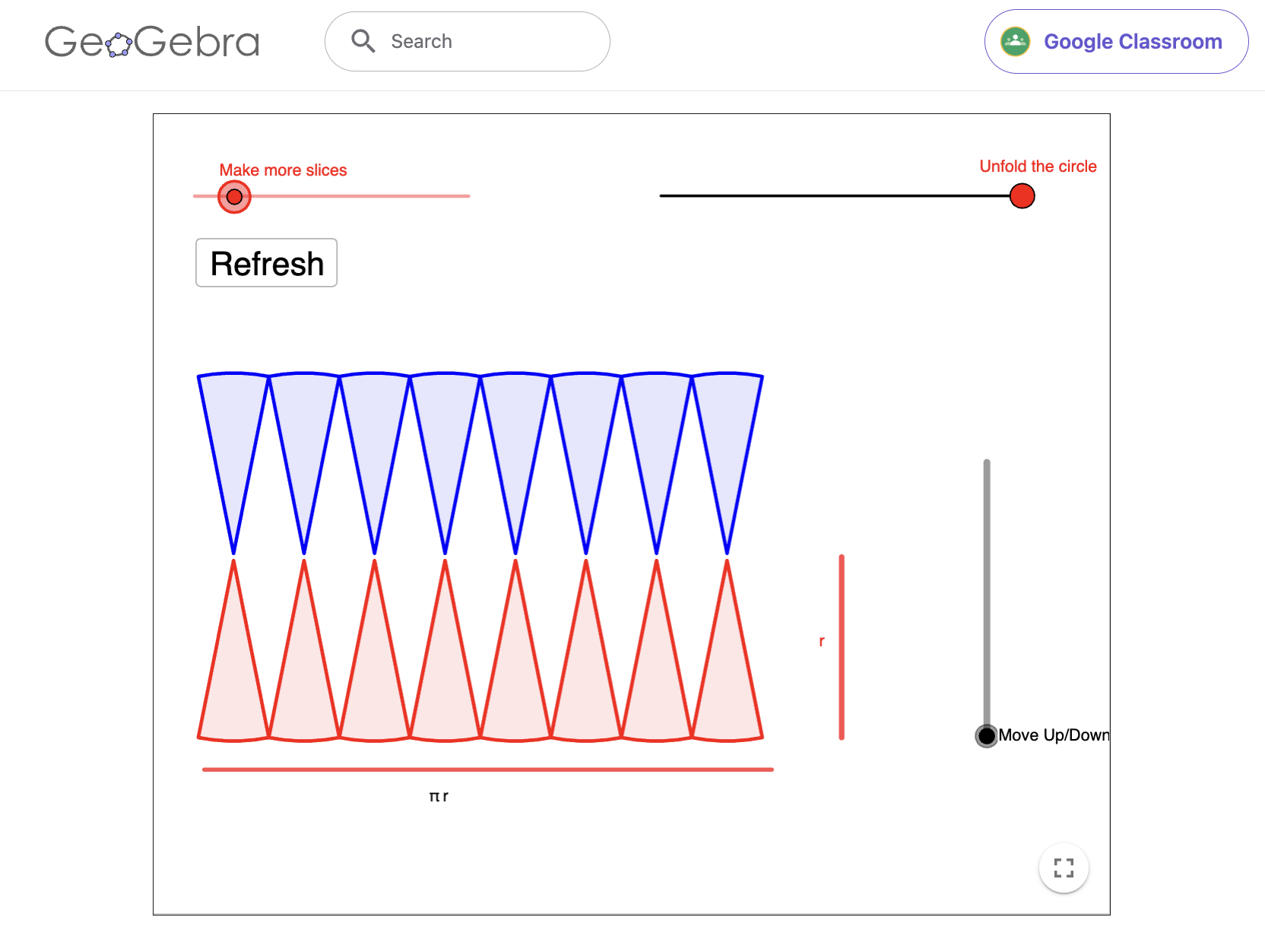
The same applies to the area of a triangle. Students may memorize the formula, but dynamic tools allow them to adjust the base and height, observe what changes and what stays fixed, and compare different triangles with the same area. This helps shift the focus from "using a formula" to understanding the relationship between quantities. When students move a vertex and see that the area remains constant as long as the base and perpendicular height remain unchanged, they begin may gain a deeper understanding of the underlying structure of the formula itself. Technology and multiple representations may help make the features of the concept more visible.
Exploring Functions, Probability, and Patterns
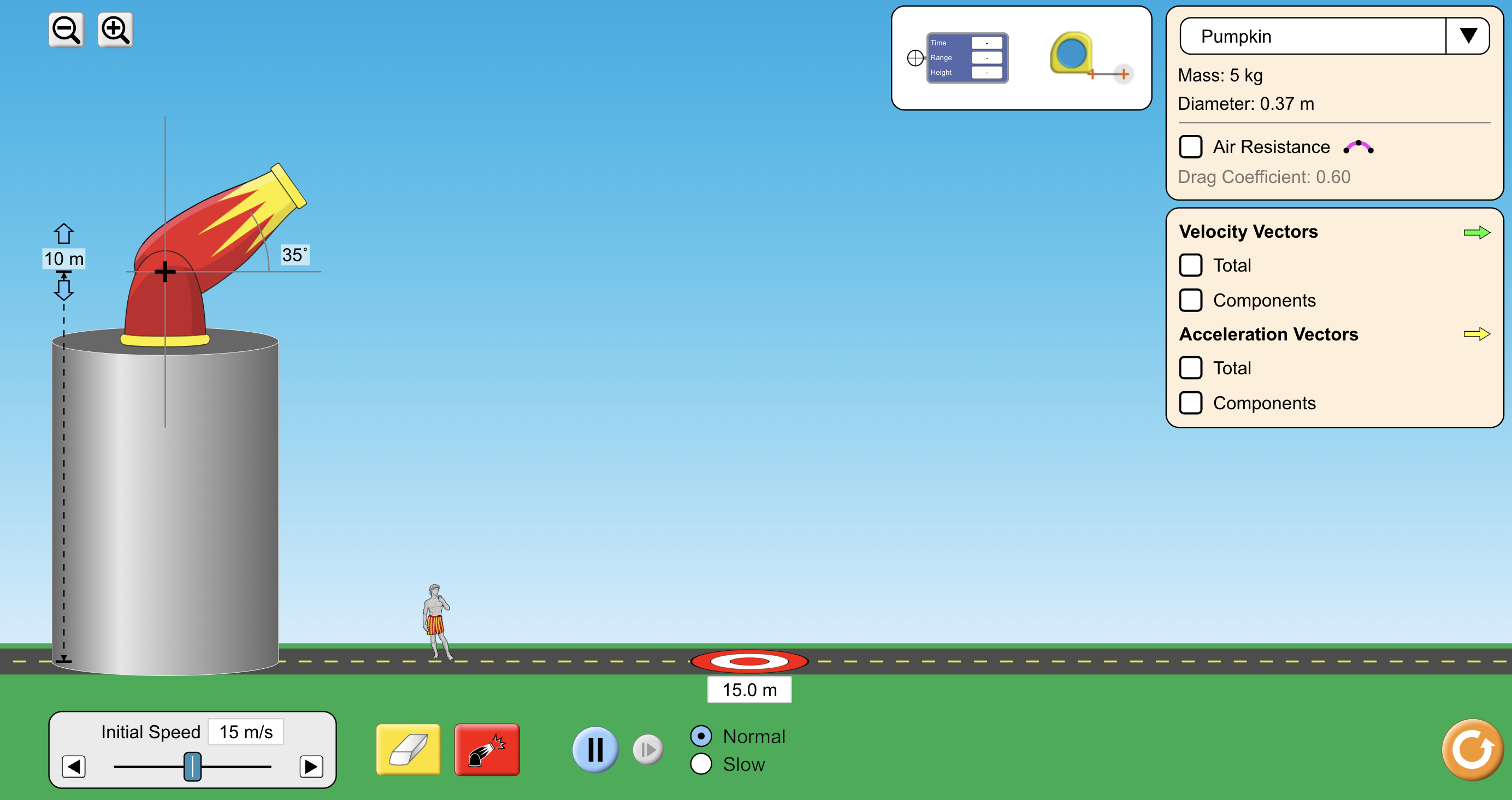
Quadratic functions offer another strong example. Students often learn quadratics as procedures, where we expand, factor, complete the square, find the vertex, and identify intercepts. These skills are important, but can potentially feel disconnected if students do not understand the shape and meaning of the function. With Desmos or a PhET-style simulation, students can adjust parameters and immediately see the effect on a parabola. They can test what happens when a coefficient changes, when the vertex shifts, or when the equation is written in a different form. Instead of being told that a parameter affects vertical stretch or reflection, students can observe it, make predictions, and then test these predictions. This feedback supports mathematical exploration and the forming of conjectures, which is central to authentic mathematical thinking.
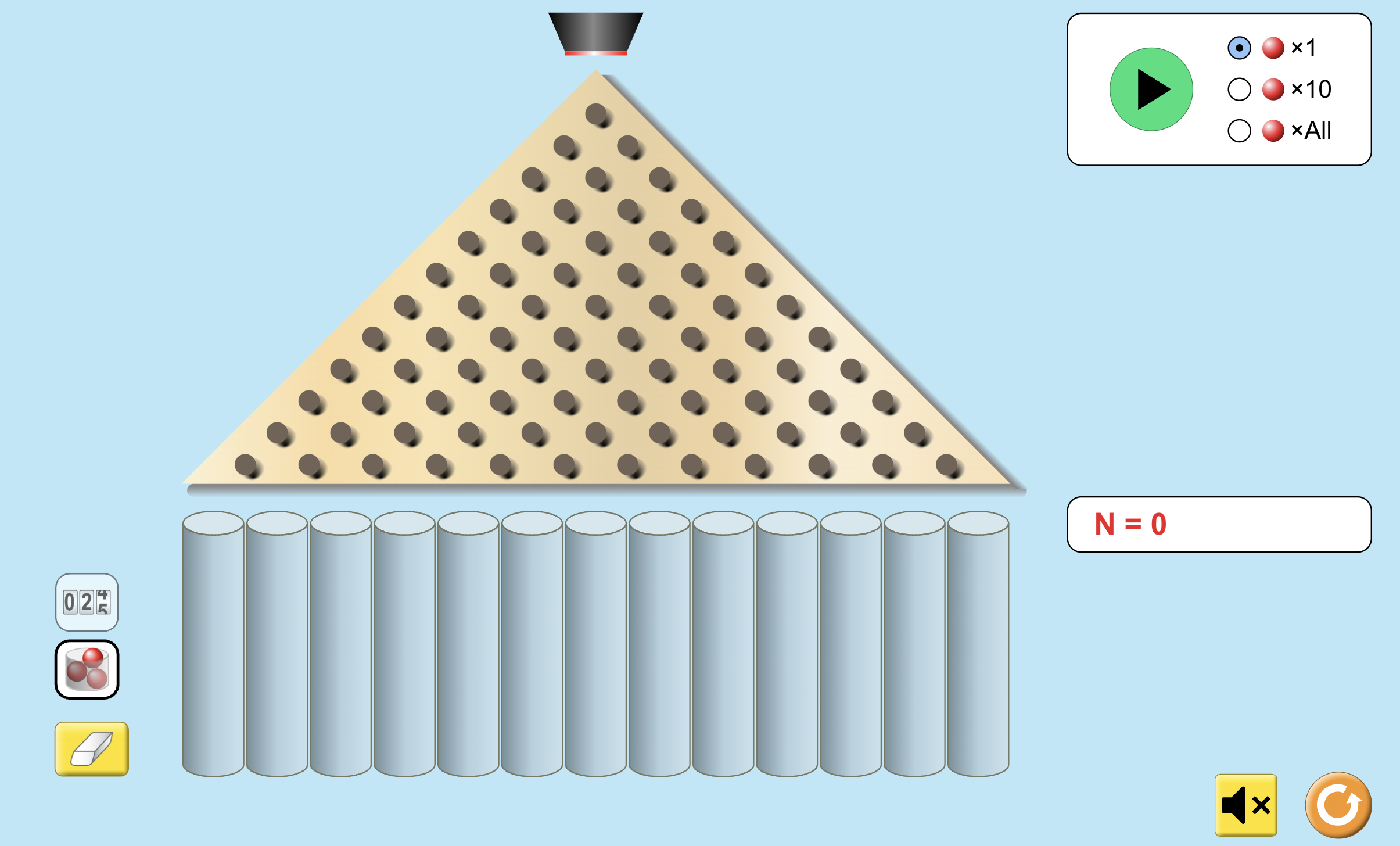
Probability is another area where technology can make abstract ideas feel more concrete. A binomial distribution, for example, can be difficult to understand if students only work with the formula itself. A Galton board or Plinko-style simulation allows students to observe repeated trials approximating into a distribution. Students can then connect an everyday visual experiment to formal probability, which in turn may help extend their intuition and statistical reasoning.
Practical Implementation and Classroom Use
A major benefit of tools like GeoGebra and Desmos is their low barrier to entry. Teachers do not always need to build every activity from scratch. Both platforms have large communities of individuals who share applets, classroom activities, and interactive demonstrations. These can often be adapted to fit a particular lesson or group of students. This matters as educational technology is most useful when it is tailored to the specific learning goal.
Desmos activities can also extend multiple representations beyond a single demonstration. A teacher can design a sequence where students first make predictions before manipulating parameters, and later explain or compare their reasoning with others. Students may be asked to justify their responses or explain how changing a parameter affects a given situation. These activities can be self-paced while still allowing the teacher to monitor progress and identify misconceptions. In this way, technology can support both independence and teacher responsiveness.
Choosing Technology with Purpose
The key point is that technology should not simply be appended to a lesson. Its value lies in helping students make connections. Visual representations, symbolic expressions, tables, real-world contexts, and verbal explanations all reveal different aspects of a mathematical idea. When students learn to move between these representations, they are more likely to develop flexible understanding.
For mathematics teachers, the question may not be "How can I use more technology?" but rather, "Which representation will help students see the structure of this idea?" Sometimes the best tool may be GeoGebra. Sometimes it may be Desmos. Sometimes it may be a quick PhET simulation, a hand-drawn diagram, or a physical model. Technology is most powerful when it supports the mathematical goal and helps students move from concrete experience toward symbolic and later abstract reasoning.
Conclusion
Leveraging technology and multiple representations provides teachers with greater options, but it also requires careful planning and judgment. Used well, digital tools can reduce unnecessary cognitive barriers, support multiple pathways into a concept, and invite students to explore mathematics more dynamically. For educators, the opportunity is not merely to add technology to existing lessons, but to use technology to make mathematical relationships more visible, connected, and meaningful.
References
Ainsworth, S. (1999). The functions of multiple representations. Computers & Education, 33(2–3), 131–152. https://doi.org/10.1016/S0360-1315(99)00029-9
Mayer, R. E. (2005). Cognitive theory of multimedia learning. In R. E. Mayer (Ed.), The Cambridge handbook of multimedia learning (pp. 31–48). Cambridge University Press.
Paas, F., Renkl, A., & Sweller, J. (2003). Cognitive load theory and instructional design: Recent developments. Educational Psychologist, 38(1), 1–4. https://doi.org/10.1207/S15326985EP3801_1
Sweller, J. (1988). Cognitive load during problem solving: Effects on learning. Cognitive Science, 12(2), 257–285. https://doi.org/10.1207/s15516709cog1202_4